In the year 2025, this is a far more complex question than it appears at face value. If you’ve ever been outside and taken a breath of fresh air, then you already understand much of what I’ll discuss here! This blog is a perfect place to start for all levels of expertise.
This article covers the basics, and provides a series of causal relationships within our Earth Systems that help to make understanding climate change as simple as looking out the window.
The Facts
Usually, when we discuss climate change in 2025, we are usually refering to anthropogenic climate change, meaning, climate changes due primarily to human activity. That’s not the only type of climate change, but it is the type we are currently dealing with. Over geologic time, our planet has been subject to many cycles of natural climatic changes. The rise in global tempterature we’re currently experiencing doesn’t resemble those past climatic changes. The reasons why this climate change looks different from those can be complicated[^1]. However, four simple, interconnected facts about the natural world, is all you really need to get started in connecting the many dots of our climate system!
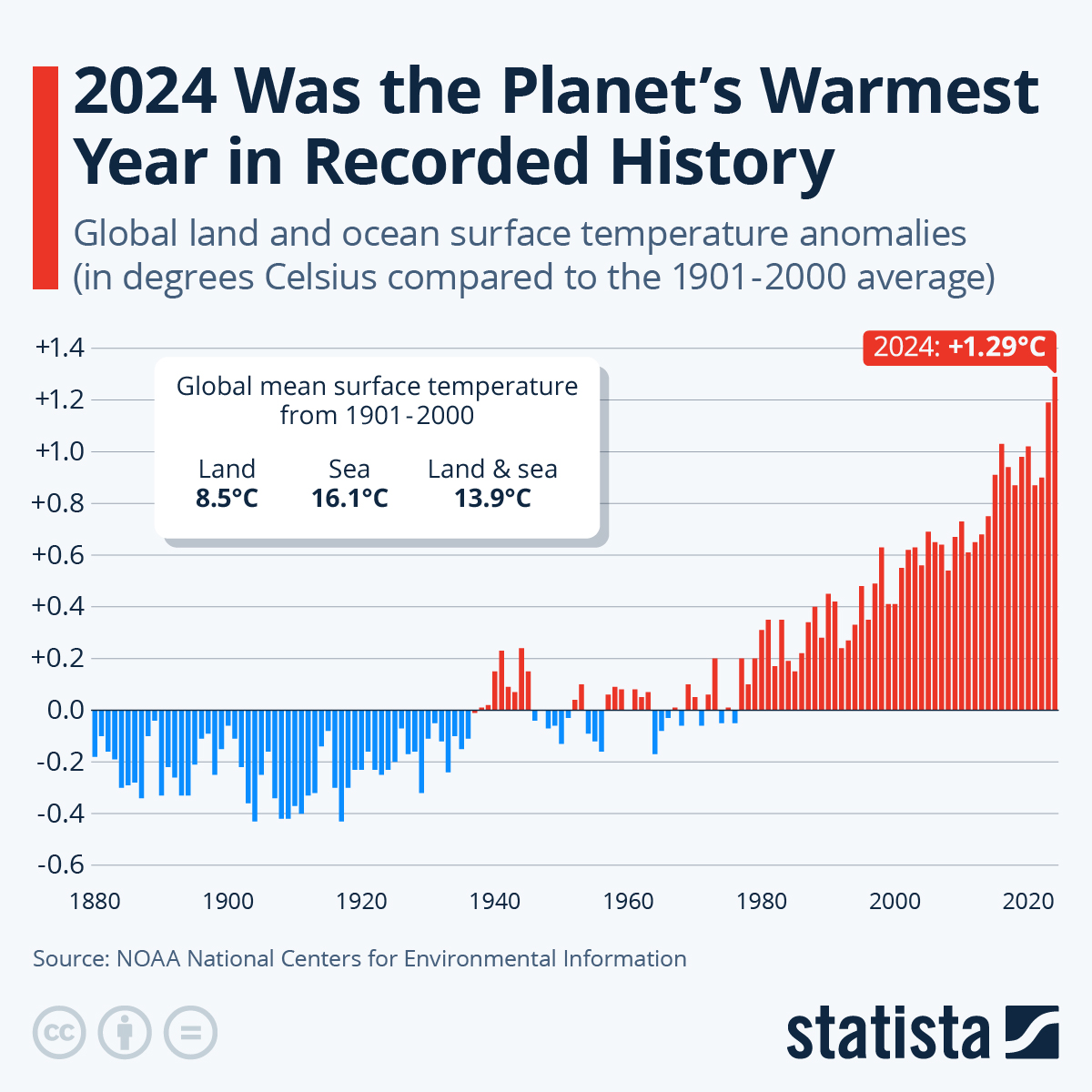
Global Average temperatures since the industrial revolution have been steadly climbing. 2024 was the warmest year on record.
Fact #1: Carbon Dioxide absorbs more heat than Air
Molecules are a great place to begin to understand the most important relationship in climate study, that of Carbon Dioxide (CO2.) and Air Temperature. Well of course, you won’t find “Air” on the periodic Table, Air in this case refers to the specific mix of gasses that makes up the majority of our atmosphere. Air mostly Nitrogen and Oxygen, but there are many other trace elements as well.
Many of these elements, and molecules are called greenhouse gasses, or GHGs. Greenhouse gasses are the gases in the atmosphere of a planet, that absorb heat energy and keep a planet warm. Sometimes, a little too warm. The process by which a planet’s atmosphere absorbs heat is called the Greenhouse Effect! The greenhouse gas of most concern to us is Carbon Dioxide (CO2). We know a lot about the relationship between CO2 and air temperature now. But that understanding needed to start somewhere, and so do we!
In November 1856, Connecticut Native Eunice Foote published the results of a very simple experiment in her paper “Circumstances Affecting the Heat of the Sun’s Rays” published in the American Journal of Art and Science. In her Experiment, Ms. Foote filled one vessel with “common air”, and another with what was at the time called Carbonic Acid Gas or CO2 as we know it today. I will allow Ms. Foote to describe her own results. Note: Temperatures in the Table below are given in °F, but are presented exactly as Ms. Foote did in the original article
"The highest effect of the sun's rays I have found to be in carbonic acid gas. One of the recievers (vessels) was filled with it, the other with common air, and the result was as follows:The reciever containing the gas (CO2) became itself much heated---very sensibly more so than the other---and on being removed, it was many times as long in the cooling" Eunice Foote, 1856
In Common Air In Carbonic Acid Gas |In shade.| In sun. | |--|--| |80| 90| |81| 94| |80| 99| |81| 100| |In shade.| In sun.| |--|--| |80| 90| |84| 100| |84| 110| |85| 120|
And just like that, a discovery was made that carries far more relevance in 2025 than it did in the leadup to Abe Lincoln’s Election. To Boil that discovery down to a single sentence? Carbon Dioxide gas (CO2) absorbs more heat than common air, and takes much longer to cool down.
Okay, so we’ve established that Carbon Dioxide is good at absorbing heat, (And that we’ve known it for nearly two centuries), lets take alook at some evidence of this in action from our nearest neighbors, the terrestrial planets! They will help us to explain our second fact.
Fact #2: An atmosphere with more CO2 will absorb more heat than one with less CO2
Greenhouse Gasses exist in the atmospheres of many planets, and depending on the chemical composition, they will absorb heat at different rates. Carbon Dioxide (CO2), Methane (CH4), Nitrous Oxide (N2O), and Water Vapor (H2O)[^2] , are, in that order the most impactful greenhouse gasses we have in our atmosphere. (H2O holds the most heat overall, but it precipitates out of the atmosphere as rain!) On Earth, until very recently and with few exceptions, our greenhouse effect was in balance. Meaning the earth eventually lost all of the extra heat it absorbed. Other planets are not so lucky. (Image of the greenhouse Effect)
Take Earth’s “Evil Twin” for instance. Venus is a very hot planet. Its even hotter than Mercury which is closer to the sun. Why? Because of its Atmosphere! Carbon Dioxide on Venus is like Nitrogen on Earth, it is the primary gas in Venus’s atmosphere.
| Earth | Venus |
|---|---|
| 78% Nitrogen (N2) | 96% Carbon Dioxide (CO2) |
| 21% Oxygen (O2 | 3% Nitrogen (N2) |
| ~Argon (Ar) | 1% other gasses |
| <1% Other Gasses |
H2O
What is the result? What we call a runaway greenhouse effect. A runaway greenhouse effect occurs when every day, little by little, a planet holds on to just a little bit more heat than it did the day before, and releases a little less back into space too. This means that a when planet’s greenhouse effect is out of balance, and will continue to heat up, as long as the amount of available greenhouse gasses continues to increase.
(Image comparing earth and venus makeup and temps)
Fact #3: There is more CO2 in the atmosphere right now than there has been for nearly 3-3.3 Million years
At the time of writing, the CO2 concentration in the Earth’s atmosphere is 427.23 parts-per-million (ppm). That means that if you split the atmosphere into 1 Million parts, 427.23 of those parts would be CO2 (It’s like a percent with a few more zeroes!). It doesn’t sound like a lot on the surface, but as always, context is very important here. The last time the CO2 concentrations were as high as they are today, it was the Pliocene epoch nearly 3 million years ago. For reference, thats when the Himalayas and the ithsmus of Panama were formed, the latter part of the Pliocene saw the rise of modern humans. What does this mean for the climate?
*It means here is more CO2 in the atmosphere right now than there has been since Homo sapiens evoloved**, What’s more, the last time the atmosphere even crossed 300 ppm was 800,000 years ago!
Lets look at some more digestible time scales to help put this into context, say perhaps, a (young!) human life. I was born 32 years ago, the CO2 concentration in the atmosphere was 357.13 parts-per-million. it has increased by 64.42 ppm in my short lifetime (the 32 years prior to 1993 saw an increase in 39.40ppm, for context). Normally, a 64ppm swing takes 100,000 years, not 32. If you would like to look at your own numbers, the Nature Conservancy has an awesome tool to examine your birth year a little more closely.
Since March of 1958, The Scripps Institution of Oceanography and UC San Diego have monitored atmospheric CO2 data from the Mauna Loa Observatory. Named for its creator, Dave Keeling, the keeling curve shows the result of this decades-long progress. Each and every year, CO2 concentrations in the atmosphere accumulate over the northern hemisphere winter, as the Northern Forests lie dormant. As spring arrives and life returns, The mighty Taiga forests of Canada and Russia take up as much of this CO2 as they can. But as they return to dormancy in the autumn, we find that they didn’t take up enough. The cycle then repeats, albeit with a different starting point.
Fact #4: CO2 concentrations in the Earth’s Atmosphere has increased at a faster rate since the Industrial Revolution in 1850 than it has in all geoloic history.
All[^3] of the energy used on the Earth comes from the Sun. It’s just a matter of when that energy was recieved.
Right now, as you read this, your brain is burning energy in the form of calories. Presumably, those calories were gained from food. Humans get our energy from consuming generally plants (that grow using solar energy), and/or animals (Which also need to eat!). So in a manner of speaking, we are eating sunlight-by-proxy! For millions of years, living organisms on Earth were limited to the amount of solar energy they could get in a day. However, for one brief period of Earth’s life, the planet learned to save some solar energy for later. 359-299 Million Years ago, called Carboniferous period. During the Carboniferous, life on Earth was flourishing. While the Tree-like lycopods thrived, the microbes that could break them down would not evolve for some 60 million more years. So these plants died, and decomposed very slowly, in a very swampy evironment. There was nothing to tke up the energy that the plants absorbed in their life, so that energy remained stored for 300 Million years in what today are coal deposits. a bit later, in the Mesozoic, marine algaes and phytoplanktons absorbed their solar energy, died, and stored that spare energy in what would eventually become oil and natural gas deposits. These are our fossil fuels. Energy from the sun, absorbed by organisms, and stored deep in the earth for millions of years, not unlike a battery.
All of this is to say, that the industrial revolution gave humanity access to more energy per day than the sun could provide. The great limitation of life on earth, available energy, was finally broken. This technological leap for humankind did not come without cost. As we burn fossil fuels to power our society, we finally release the energy those ancient plants stored millions of years ago. For the first time since time, the Earth’s energy Budget was out of balance. These fossil fuels emit CO2 as a byproduct of burning. CO2 is, of course, naturally occurring in the atmosphere, you make it with each breath, volcanoes belch it, wildfires release it. We know this, and account for it. We know how much CO2 is emitted every year through natural means. It is simply not enough to cause the climatic changes we have seen in the last two centuries. We also know how much CO2 human activity emits every year, and it turns out it is enough to explain these climatic changes
[^1] [^2]: Water Vapor (Water in its invisible gaseous form) is a strong greenhouse gas, but it does not stay in the atmosphere long, as it regularly precipitates out as rain! [^3]: Geothermal energy notwithstanding
]]>